
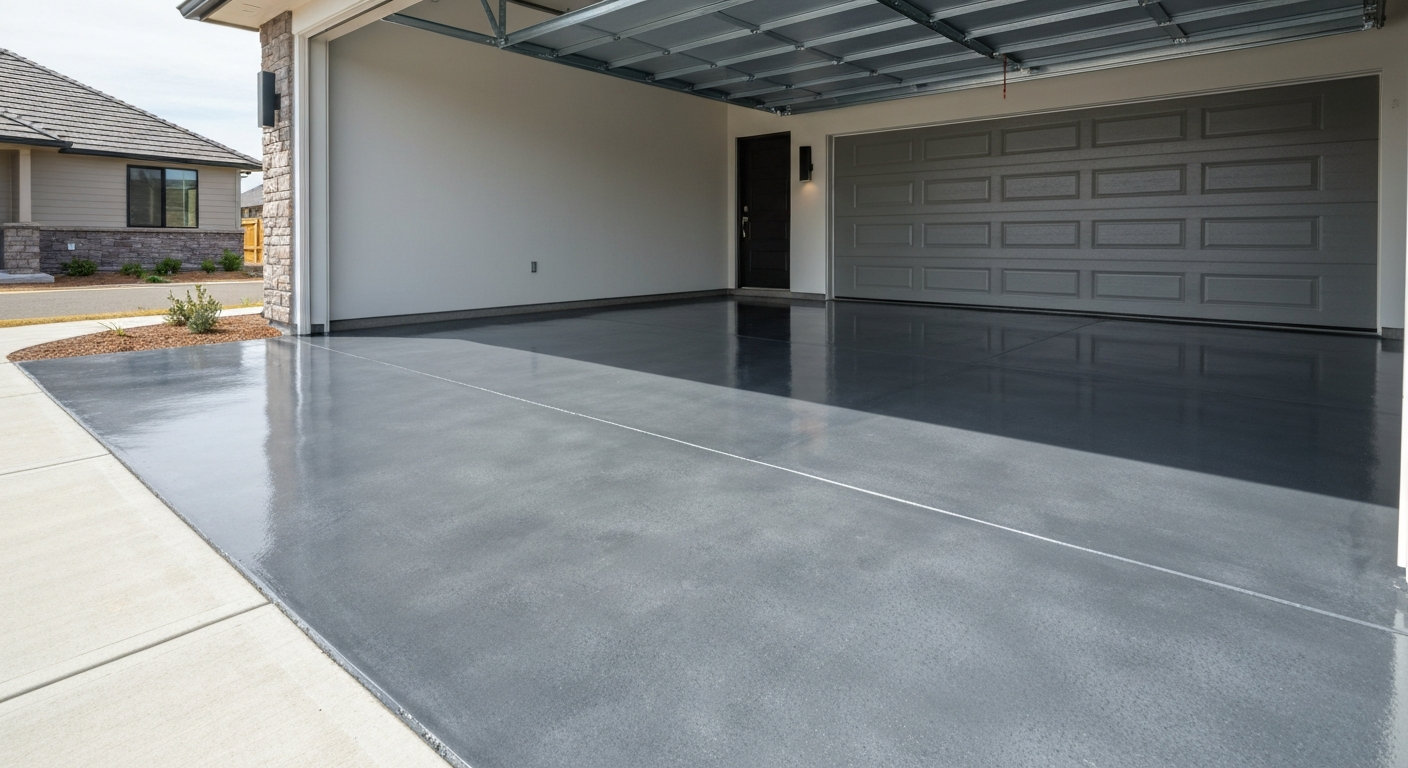
Sandy's Ski-Season Lifestyle Demands a Garage Floor Built to Handle It
Sandy sits at the base of the Wasatch Mountains. Every return trip from a ski day brings road salt, snow melt, and deicing chemicals onto the garage floor. A properly installed epoxy and polyaspartic floor coating changes that calculation permanently.
Why Sandy Garages Need More Than Basic Epoxy
Not all epoxy floor coatings are equal — and Sandy's climate and lifestyle demands make system selection particularly important.
The road salt problem. Salt Lake County's road maintenance departments apply significant quantities of magnesium chloride and sodium chloride to Wasatch Front roads during winter weather events. These deicing chemicals are highly effective at preventing ice formation — and highly corrosive to garage floors and floor coatings. Standard epoxy base coat, without a chemically resistant topcoat, can be attacked by road salt solutions over time, eventually compromising adhesion.
The freeze-thaw factor. Sandy's elevation (approximately 4,500 feet at the valley floor, rising significantly toward the canyons) means more freeze-thaw cycles per year than lower-elevation suburbs. Concrete expands and contracts with temperature changes, and these cycles accelerate any coating failure that begins at the edges or in crack locations.
The moisture challenge. Snow melt tracked into Sandy garages creates a wet environment for hours after each winter storm or ski day return. Moisture vapor from wet vehicles, wet ski gear, and wet footwear accumulates on the floor surface.
The right system for Sandy: A decorative chip/flake epoxy system with a polyaspartic topcoat addresses all of these factors. The base coat creates the primary adhesive bond and color foundation. The decorative chip broadcast adds texture (slip resistance on a wet surface is critical), visual depth, and a layer that disguises minor surface irregularities. The polyaspartic topcoat provides the chemical resistance that protects against road salt, the UV stability that prevents yellowing, and the hardness that resists abrasion from ski boots, hiking boots, and daily vehicle traffic.
The Installation Process — Why It Matters in Sandy
The difference between an epoxy floor that lasts 15–20 years and one that starts failing in 3–5 years is almost entirely preparation.
Step 1: Concrete Assessment
Before any installation begins, our partner specialists assess the concrete condition: surface hardness, crack locations, oil saturation areas, and moisture vapor emission. In Sandy garages, oil saturation from decades of ski season vehicles is common. Significantly saturated concrete requires targeted degreasing after grinding.
Step 2: Diamond Grinding
The concrete surface is diamond-ground using a planetary grinder — a process that mechanically removes the top layer of concrete, opens the pores for maximum epoxy penetration, and removes oil contamination, previous coatings, and surface irregularities. Acid etching produces a chemically altered surface that doesn't achieve the mechanical profile that maximizes adhesion.
Step 3: Crack and Spall Repair
Cracks are routed and filled with flexible epoxy crack filler. Spalled areas (where the concrete surface has chipped or flaked) are filled and leveled. Cracks that aren't addressed before coating will telegraph through the finished surface.
Step 4: Base Coat Application
Epoxy base coat is applied and allowed to partially cure. The base coat is the primary adhesive layer — it penetrates the ground concrete surface and creates the mechanical and chemical bond that holds the entire system.
Step 5: Decorative Chip Broadcast
While the base coat is still tacky, vinyl chip flakes are broadcast to rejection (full coverage) across the surface. The chips embed partially into the base coat, creating texture and the decorative visual effect. After cure, excess chips are vacuumed.
Step 6: Polyaspartic Topcoat
One or two coats of polyaspartic are applied over the prepared chip surface. Polyaspartic is a fast-cure, UV-stable, chemically resistant coating that provides the wear surface homeowners walk and drive on. Walk-on in 12–18 hours. Vehicles in 24 hours.
Epoxy System Options for Sandy Garages
Standard Decorative Chip
$3–$5/sq ft
The most popular and practical choice for Sandy's utilitarian garage environment. Chip blend in your color choice, polyaspartic topcoat. Proven performance, excellent durability, slip resistance.
Premium Decorative Chip
$4–$6/sq ft
Higher-quality base coat materials, full double broadcast chip for maximum coverage, two-coat polyaspartic topcoat for maximum hardness and chemical resistance. Best for heavily used garages.
Metallic Epoxy
$7–$12/sq ft
Metallic pigments mixed into the epoxy base create a three-dimensional, one-of-a-kind appearance. Polyaspartic topcoat required. Best for homeowners who want the garage floor to be a visual feature.
Solid-Color System
$3–$5/sq ft
A single uniform color with polyaspartic topcoat. Clean, contemporary, no chip texture. Popular in workshop configurations where visual cleanliness is prioritized over decorative effect.
Epoxy Flooring Cost in Sandy, Utah
| System | Cost per Sq Ft | 2-Car Garage (450 sq ft) | 3-Car Garage (650 sq ft) |
|---|---|---|---|
| Standard chip + polyaspartic | $3–$5 | $1,800–$3,200 | $2,600–$4,600 |
| Premium chip + double topcoat | $4–$6 | $2,400–$3,800 | $3,500–$5,500 |
| Metallic epoxy + polyaspartic | $7–$12 | $4,200–$7,200 | $6,000–$10,400 |
| Solid color + polyaspartic | $3–$5 | $1,800–$3,200 | $2,600–$4,600 |
*Concrete preparation is included in these ranges for standard conditions. Severely damaged concrete, extensive crack networks, or high moisture vapor emission may require additional preparation work, which is disclosed at the free consultation.
Sandy-Specific Application Considerations
- •Spring is popular: After ski season ends, the garage has experienced its full winter load. Spring allows the floor to cure before the next ski season.
- •Winter installation: Possible with preparation. The garage must be heated to bring concrete surface temperature above 50°F.
- •Drain placement: Sandy garages with center floor drains should have these assessed before coating to preserve functionality.
Frequently Asked Questions
Everything you need to know about epoxy flooring in Sandy, Utah.
Areas Near Sandy We Also Serve
Our qualified partner network serves Sandy and surrounding communities:
- 📍 Sandy (all neighborhoods — 84070, 84090, 84092)
- 📍 Draper — 10 minutes south
- 📍 Murray — 10 minutes north
- 📍 Midvale — 10 minutes northwest
- 📍 Cottonwood Heights — 10 minutes northeast
Related Resources
Your Sandy Epoxy Floor Starts Here
Your Sandy garage floor has survived ski seasons, summer mountain biking, and years of daily vehicle traffic. It's earned an upgrade — one that's been engineered for the demands of your outdoor lifestyle and the specific challenges of a Wasatch Front winter.
Free, no-obligation consultation at your Sandy home
Honest assessment of your concrete's condition
Physical color samples viewed in your garage's lighting
Written estimate with clear scope and pricing